Introducing Arthaus Pigment™
Art, understood.
Making,
made visible.
A painting carries a way of seeing. How light gathers on water. How a line gives a landscape movement. How colour changes the feeling of a place.
Arthaus Pigment™ is our evolving technology for connecting those ideas to artists, source literature and new digital works. Its artist genome connects the artistic ideas; its brush engine gives that exploration a recorded, replayable form.
Read the story behind the technology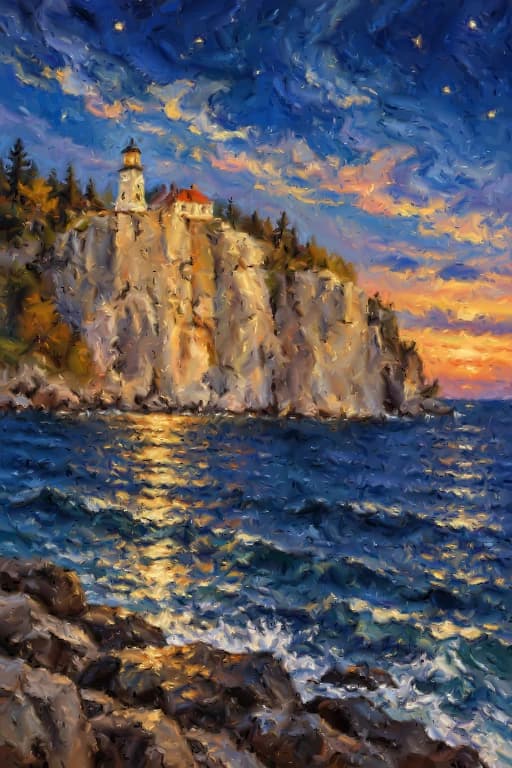
Recorded study · interactive light
16,366 recorded marks · The finished study
Four saved construction stages, rendered live in your browser. Paint height is a simulation; values above 1× exaggerate it to reveal the surface.
Activate to load the interactive canvas. No automatic motion.
A Beacon Against the Blue · Split Rock Lighthouse, inspired by Vincent van Gogh. An original digital study, with a simulated material surface.
01 · The artist genome
A person.
A lifetime of work.
A way of seeing.
Monet is more than a palette. Van Gogh is more than a swirling sky. Artists experiment, borrow, change direction and return to ideas across their lives. Their work deserves a richer starting point than a name attached to a visual effect.
We use artist genome to describe a structured, evolving map of artistic concepts: colour relationships, edge treatment, spatial construction, mark rhythm, materials and subject. Each artist remains a real historical person, connected to works and the literature around them.
The map begins with candidate claims extracted from source material. Related terms are normalized, references retained and disagreements kept open for review. A claim about one work or period should stay attached to that context. The aim is a compact, useful vocabulary that can grow with evidence.
This is a research model of selected artistic characteristics. Its value comes from what we can explain, test and improve.
02 · Learning to look
From words about art
to things we can observe.
“Luminous”, “restless”, “soft”: criticism can describe an experience beautifully. Connecting that language to a visible choice takes closer looking. Our research pairs textual evidence with observations of artworks, working from individual marks to the whole composition.
Colour & light
Which colours sit beside one another? Where does contrast pull the eye? Is distance described through tone, saturation or softened edges?
Marks & materials
How are strokes repeated, oriented and layered? What can an image reveal about texture—and what remains uncertain without examining the physical work?
Structure & space
How do shapes organize the picture? Where are forms simplified, viewpoints shifted or silhouettes held steady against movement?
The research direction brings together local texture features, whole-image visual representations and language. Those observations help us investigate an interpretation; they are not yet calibrated measurements of an artist’s style or the physical properties of paint.
03 · Inside Pigment
Give the image
a construction history.
The current workflow first develops an AI-assisted composition using selected visual directions. A separate brush stage fits simulated marks to that image guide. Each accepted mark becomes part of a stored program, so the resulting native painting can be constructed again and its development inspected.
The studies below show that recorded process. Early marks establish broad areas; later marks develop the surface. The films accelerate the sequence. The newer showcase compositions and their brush reconstructions are separate images, each labelled in the gallery.
A working research studio
Watch a canvas emerge.
These films replay the original landmark brush studies. They show the construction of the paintings here.
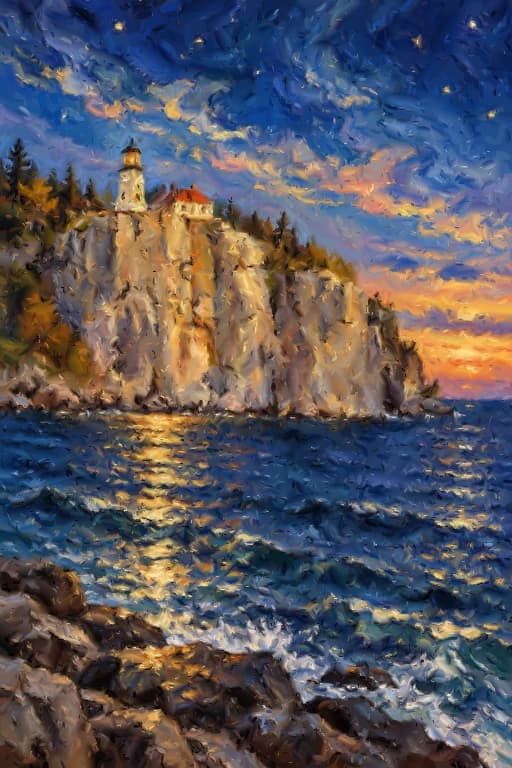
Simulated paint on a digital canvas. Playback is accelerated; it is not footage of a person painting.
Split Rock Lighthouse · Minnesota
A Beacon Against the Blue
Inspired by Vincent van Gogh
Ideas we explored
Directional paint marks, deep blues and a little golden light.
These are source-informed creative directions. The study is an interpretation, with room for further review.
What the engine records
A sequence of brush commands that can be replayed to reconstruct the native painting. The current research fits marks to an image guide; it does not reproduce the artist’s original hand movements.
04 · Paint & light
A surface worth
looking around.
A painting is also a surface. In the material experiment, recorded marks contribute both colour and an assumed paint height. Moving a light across that surface reveals another way to look at the work.
The interactive canvas at the top uses four saved states from the lighthouse construction. You can turn the canvas, change the light and emphasize its relief. The geometry and lighting are rendered live; the stages are recorded checkpoints.
Return to the interactive canvas ↑The 3D construction film follows all 16,366 stored marks in order. Height and material response are simulation assumptions, not measurements of historical paint. Added lighting changes the presentation of the recorded colours.
05 · The making story
An artwork with
something more to discover.
The finished image is the beginning of the experience. A companion story can explain the artist references, describe the visual choices and let someone watch the painting emerge. A scan from a framed work could open that story wherever the painting lives.
The research samples already retain prompts, source references, construction programs and replay checks. The product direction is to turn these into an inviting editorial experience, with optional films and interactive views attached to the specific artwork purchased.
The connection to Living Memory begins with the memory itself: your selected photographs, approved story and the details you want to keep. Those shape the artistic brief. The painting offers one interpretation; the companion experience can bring you back to the photographs, voices and meaning behind it.
We are designing a way to explore “the memory”, “the painting” and “the making” together. Personal making stories and brush replays are a planned viewer extension, demonstrated here through research studies.
See how this connects to Living MemoryThe inspiration
Artist and work references, the selected concepts, and the context of the interpretation.
The construction
The recorded brush program and the image it actually produced, with matching replay media.
The reflection
A making story that distinguishes observable decisions from interpretation, with sources for further exploration.
06 · An open research horizon
Built to evolve.
Clear about where we are.
Explore today
Twenty artist-inspired landmark studies. Three newer showcase compositions with separate native reconstructions. Recorded construction films, source notes, and the material experiment you can explore here.
AI generation is part of the workflow. The brush stage currently uses image-guided fitting. Exact replay can verify the construction; evaluating artistic fidelity requires a different kind of evidence.
What we are working toward
Richer artist and period profiles. Better tests of concept alignment and creative diversity. Learned brush policies that respond to the emerging canvas. A collection where visitors can discover a finished work, choose a print and explore its making story.
These are research and product directions. We have not yet demonstrated a historically faithful learned artist hand, and the sample collection is not yet a ready-made print shop.
Your own way into the art
Begin with a place.
Stay for the possibilities.
Explore the landmark collection, or bring your own photographs and story to MemoryFrame. Available artists are shown during creation.