3 min read
How big can you print an old family photograph?
The limit is set by the damage, not the megapixels. A faded 1974 snapshot carries a 12x12 print; the same image at 20x28 is enlarged past its detail.
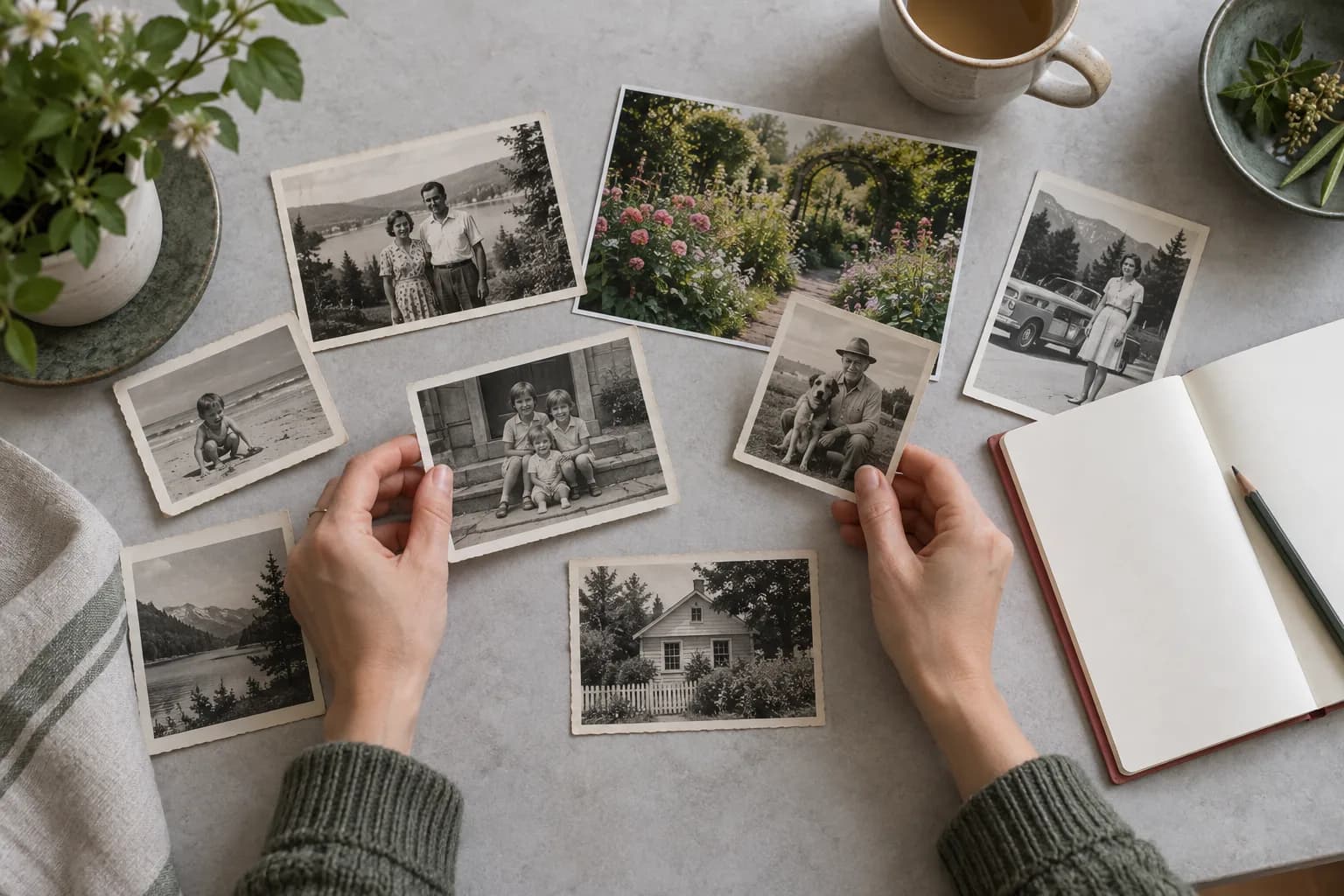
A damaged snapshot will carry a 12×12 print. The same photograph asked to fill 20×28 is being enlarged past the detail it actually holds, and no amount of processing puts back what the negative never recorded.
That is the whole answer. The rest of this page is why, and how to tell which side of the line your photograph sits on.
Megapixels are the wrong question
The number attached to a file describes how many pixels there are, not how much of the photograph is really in them. A 1974 print that has been in a drawer for fifty years, photographed on a phone, produces a large file full of soft edges, scanner grain and colour that has drifted toward magenta. The file is big. The photograph is not.
What matters is how much genuine detail survives — the edge of a coat, the lettering on a suitcase, the line of a jaw. Those are the things an enlargement either has to work with or has to invent.
There is a range where enlarging works, and a range where it guesses
Roughly 1.3× to 1.75× is the faithful range. In it, reconstruction is recovering structure that is genuinely present, and the result looks like the photograph you remember, only larger.
Past about 3.5×, the process is no longer recovering anything. It is predicting what should plausibly be there. That prediction is usually attractive and it is not your photograph.
This is not a matter of taste. It is why our products are sized the way they are: each one is deliberately positioned so the enlargement stays inside the faithful range rather than being pushed past it to hit a bigger number on a price list.
There is a hard technical edge here too. The reconstruction model we use refuses input above roughly 2.1 megapixels outright — it will not accept a very large source at all — which is a useful reminder that these tools have operating ranges rather than infinite headroom.
What this means for choosing a size
If your photograph is:
- Old, small, soft, or the only copy — the 12×12 Classic is the honest choice, and it is not a lesser one. It is the size that particular photograph can carry.
- Sharp, well-exposed, and reasonably recent — larger sizes are genuinely available to you, including the 20×28 Heirloom.
Every print is composited at 300 dots per inch, and a source that cannot reach the floor for a requested size is refused rather than quietly printed soft. That check is ours. It is worth knowing that the printing side imposes no minimum of its own, so without it a too-small file would simply be stretched and posted.
The photograph that matters is usually the worst one you have
Most families have one picture that only one person has ever seen — in a drawer, inside a book, on a phone that replaced the phone it was taken on. It is routinely the oldest and lowest-quality image anybody has, and it is almost always the one that matters most.
That is not a problem to be solved by buying the largest thing available. It is a reason to choose the size that photograph can actually hold, and to let it be good at that size rather than disappointing at a bigger one.
Check your print dimensions
Pixel dimensions describe the image file, not the size of the original paper photograph.
Pixel count does not assess blur, damage, restoration or canvas-wrap margins. No image detail is added.
MemoryFrame
Make something from the photograph that matters
Bring your photograph and its story to MemoryFrame to begin a piece of artwork.
Start your MemoryFrame